© 2026 Rentokil Initial plc and subject to the conditions in the legal statement..
Why small operational deviations create significant financial, food safety, and customer experience risks across multi-location brands
An extra half-ounce of protein on a sandwich. A 20-second delay at the drive-thru. A temperature check recorded but never performed. Each may seem insignificant in the course of a busy shift, but repeated hundreds of times across hundreds of locations, these deviations add up to millions in losses and risks most leaders never see in a report.
For multi-location brands, the trouble lies in repetition: many of these problems are recurring weaknesses in everyday execution, sometimes reinforced by the procedures, management priorities, and incentives intended to keep operations running efficiently.
When small deviations become enterprise-wide costs
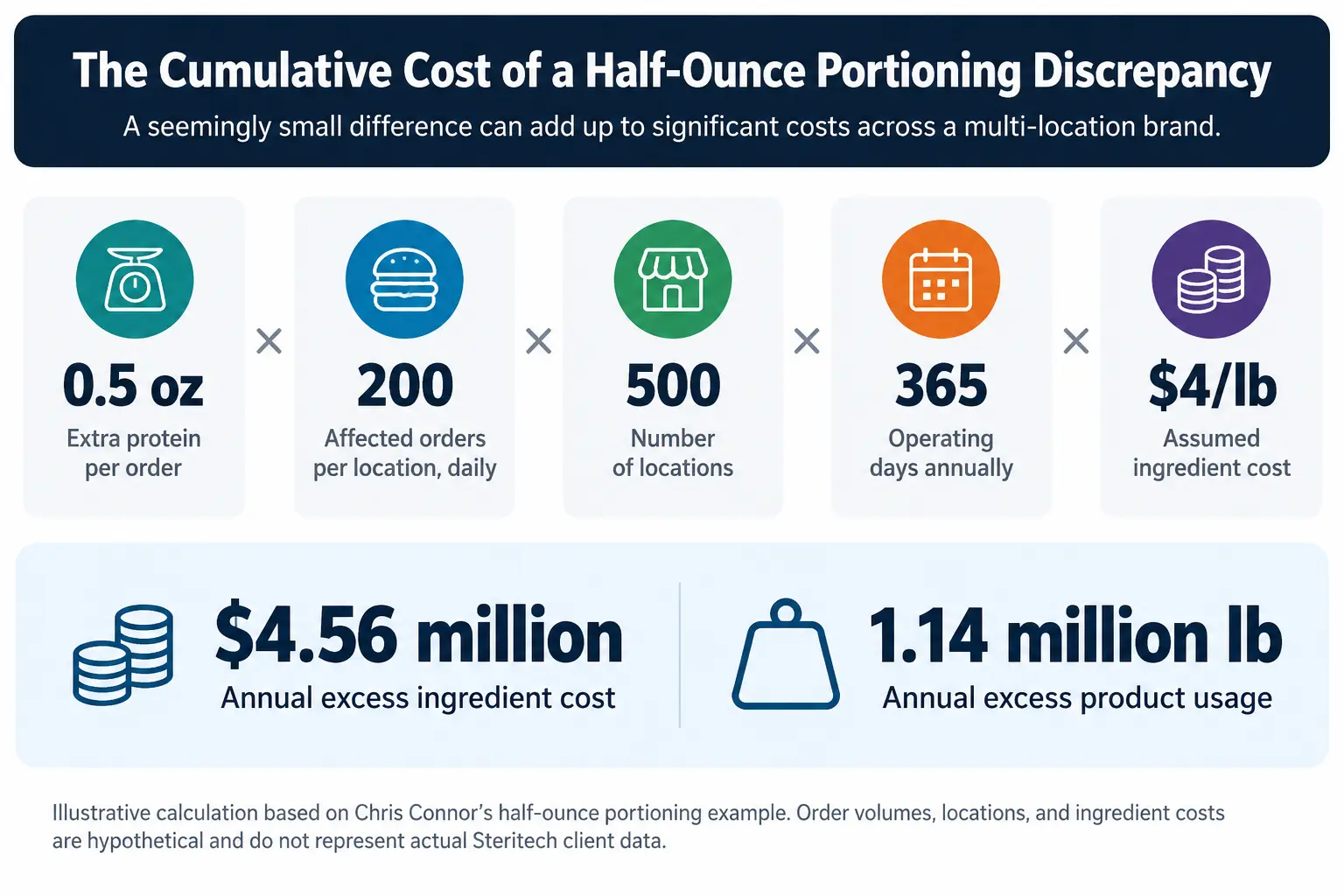
Portion control offers the easiest example to measure. An extra half-ounce of protein added to 200 orders a day amounts to roughly 2,280 pounds of additional product annually at a single location. Across 500 restaurants, that becomes about 1.14m pounds of unplanned product usage, assuming the discrepancy occurs consistently. At a hypothetical ingredient cost of $4 per pound, the excess represents approximately $4.56m in annual food costs.
Chris Connor, Director of Technical Services at Steritech, explains that the consequences extend to customer expectations. Guests accustomed to generous portions at one location may perceive the same menu item as poor value when served the correct portion elsewhere, leading to complaints and negative reviews.
Service speed presents a similar challenge. A delay of just 15 or 20 seconds per transaction can reduce throughput during busy periods, particularly in quick-service and fast-casual restaurants. Across a large network, even modest reductions in customers served can represent significant lost revenue opportunities.
Other deviations introduce risks that are harder to quantify but potentially more serious.
Connor describes how employees may overfill refrigerated preparation units to avoid restocking during rush periods, compromising the equipment’s ability to maintain safe temperatures. Temperature monitoring can also become what he calls a “pencil-pushing exercise,” with employees recording checks that were never performed or failing to correct problems they identify.
Sanitization procedures can deteriorate under similar pressures. During busy periods, employees may rush soiled dishes directly into sanitizer without properly washing them or allowing sufficient contact time. Mechanical dishmachines may continue operating without anyone verifying that they are effectively cleaning and sanitizing utensils and dishes.
In each case, the task looks finished on paper while the standard behind it has slipped. Left unchecked, those lapses can lead to foodborne illness, regulatory action, and the kind of brand damage no single location can contain. For leadership, the larger concern is how often a deficiency occurs across the organization and whether existing oversight processes can detect it.
Why the same problems keep coming back
Correcting an operational deficiency does not necessarily prevent it from recurring. A manager may discard food found outside safe holding temperatures, retrain an employee who missed a procedure, or replace an improperly labeled product. The immediate issue is resolved, but the conditions that produced it may remain unchanged.
“Employees/managers often struggle to differentiate between fixing an issue and fixing a process or system,” says Connor. When improperly held food is discarded without investigating why the temperature was incorrect, the same problem can resurface during the next shift.
Staffing pressures make recurring deficiencies more difficult to address. High turnover continually removes institutional knowledge, while abbreviated onboarding may prepare employees to complete immediate tasks without giving them a thorough understanding of brand standards, safe handling procedures, or the reasons behind them.
Management incentives can also work against operational priorities. Connor notes that managers are frequently rewarded for controlling labor costs and maintaining service speed, which can encourage shortcuts in temperature monitoring, handwashing, recipe adherence, and product quality checks.
The result can be a cycle of recurring deficiencies in which individual employees receive corrective coaching while the processes behind those deficiencies remain untouched. If employees repeatedly struggle with date marking, for example, the answer may involve simplifying labeling requirements or providing better tools. Another reminder to comply is unlikely to change the outcome.
Patterns in assessment data can help executives identify where intervention is needed. Deficiencies appearing across multiple locations may indicate shortcomings in corporate procedures or training. Problems concentrated at a single location may suggest management or equipment issues, while failures that occur primarily during peak service periods may point to unrealistic labor expectations or operational processes.
What consistent operators do differently
Organizations that sustain strong operational performance make it easier for employees to execute procedures correctly, even during peak periods, staffing shortages, and management transitions.
That begins with examining how work actually gets done. Calibrated portioning tools can reduce recipe variation. Temperature sensors can support more reliable monitoring. Simplified labeling systems can reduce errors associated with complicated date-marking requirements. Each reduces dependence on individual memory or judgment.
“Instead of relying on people remembering to be consistent and do things the right way, they create systems that ensure consistency,” Connor explains.
Consistent operators also spread accountability across the whole team. When expectations and incentives apply to everyone on the floor, employees have a direct interest in maintaining standards throughout the shift. But those expectations must balance service speed, labor efficiency, product quality, and food safety so that success in one area does not come at the expense of another.
They also incorporate oversight into daily routines through manager-led line checks, shift debriefs, self-assessments, finished-product evaluations, and corrective actions that address root causes. These practices help identify emerging problems between formal assessments and provide opportunities to intervene before deficiencies become recurring patterns.
A strong assessment result can offer reassurance, but it captures performance at a particular moment. If employees follow procedures when an assessment is expected but abandon them during busy shifts, leadership may have an incomplete picture of everyday risk exposure. Organizations that maintain standards between assessments have a more reliable basis for evaluating performance.
For senior leaders, the implications extend to how operational performance is measured and managed across the enterprise. Repeated deficiencies may indicate that procedures are unnecessarily complex, training is insufficient, equipment is inadequate, or incentives are encouraging the wrong behaviors.
A location that corrects a deficiency before its next assessment may appear to be performing well. But if the same issue repeatedly returns, the organization continues to absorb the associated costs and risks.
Consistency can be built. Every process fixed at the source returns time, labor, resources, and revenue to the business and gives leaders a more accurate view of how their locations perform every day.
Are Small Inconsistencies Putting Your Brand at Risk?
Steritech’s OnBrand360® programs help multi-location brands identify gaps in operational execution, uncover recurring deficiencies, and evaluate how consistently brand standards are maintained across locations. Gain greater visibility into the issues that may be affecting customer experience, operational performance, and your bottom line.
Explore OnBrand360® or contact us for more information.
*Data presented is gathered by Steritech through its OnBrand360®
Contact Steritech for a free survey or quote and obtain our experts will get back to you as soon as we can
Gain helpful insight from Steritech’s library of industry info and resources.