© 2026 Rentokil Initial plc and subject to the conditions in the legal statement..
At the heart of every successful brand is one key objective: consistent, high performance across all locations. This isn’t just an operational goal. It’s a business imperative. When restaurants operate consistently well, they minimize food safety risk, protect brand reputation, and deliver a guest experience that keeps customers coming back.
Consistency builds trust. It drives loyalty. And it sustains long-term growth. One of the most effective, yet often underleveraged, tools to achieve this consistency is the Self-Assessment.
External assessments provide valuable visibility, but they’re just a snapshot. What happens between those snapshots determines whether a brand’s standards truly hold. That’s where Self-Assessments come in.
What is the purpose of a self-assessment?
The most effective Self-Assessments don’t aim to look good. They aim to get better. Their purpose is to uncover vulnerabilities before they turn into violations or guest-impacting issues.
The goal should be to find the most opportunities for improvement: expired products left on the shelf, missing logs, sanitizing lapses, or unsafe behaviors. These are the gaps that could trip up a location during an external audit or trigger a health department citation.
Unfortunately, one of the most common mistakes we see is incentivizing high Self-Assessment scores. This often leads operators to gloss over real issues or give themselves inflated marks. A more effective practice is to recognize and reward the teams that identify the most meaningful opportunities for improvement. That transparency fuels progress.
Visual insight: Stricter self-scoring leads to stronger performance
Steritech’s data shows that teams who are tougher on themselves during Self-Assessments actually perform better on official audits. The chart below highlights the average Steritech audit scores based on how teams score themselves.
Perfect Self-Scorers, those who give themselves top marks across the board, tend to score lower on external assessments than teams who are more critical and honest.
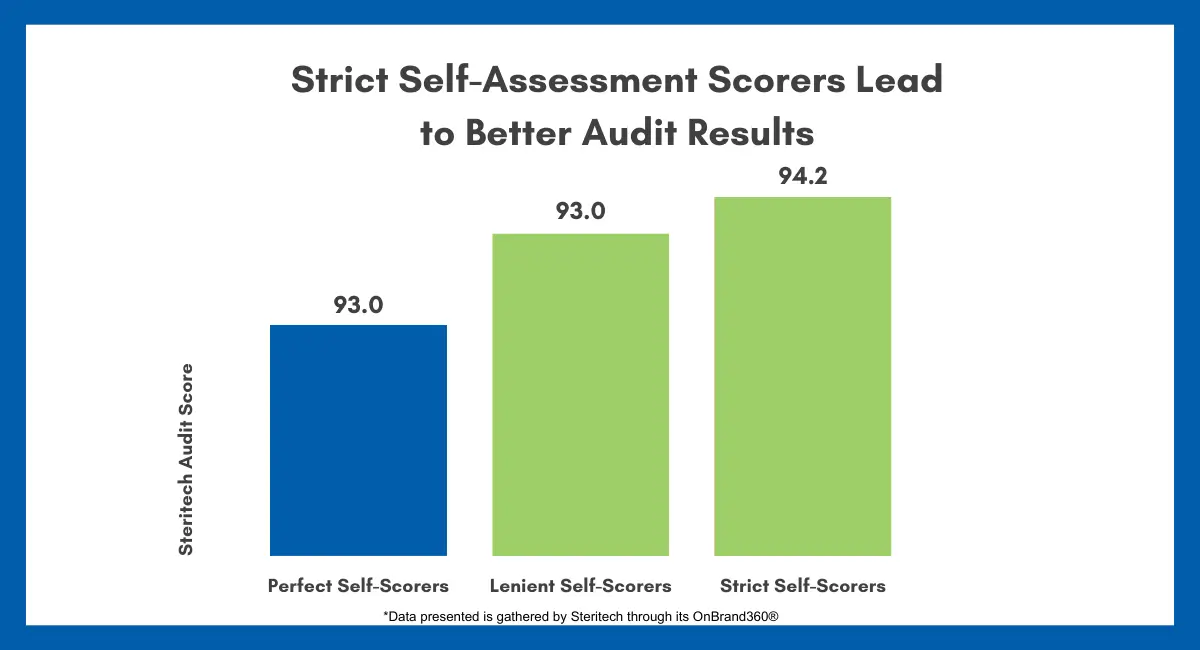
This insight reinforces a key best practice: honest Self-Assessments aren’t a risk. They’re a strategy.
Why Self-Assessments build consistent performance
High-performing teams aren’t built on reaction. They’re built on rhythm.
Self-Assessments create that rhythm. They build discipline, increase awareness, and help embed critical habits into the daily routine. They empower teams to take ownership of performance, identify gaps early, and continuously improve.
Whether led by a restaurant general manager or a shift supervisor, Self-Assessments turn expectations into daily habits. They reinforce training, support accountability, and help ensure no one is surprised when an official assessment or inspection occurs.
Quantifiable impact: Regular self-assessments lead to better scores
Steritech’s internal data makes the case for consistent self-checks clear. Locations that conducted more frequent Self-Assessments between professional assessments saw significantly better compliance.
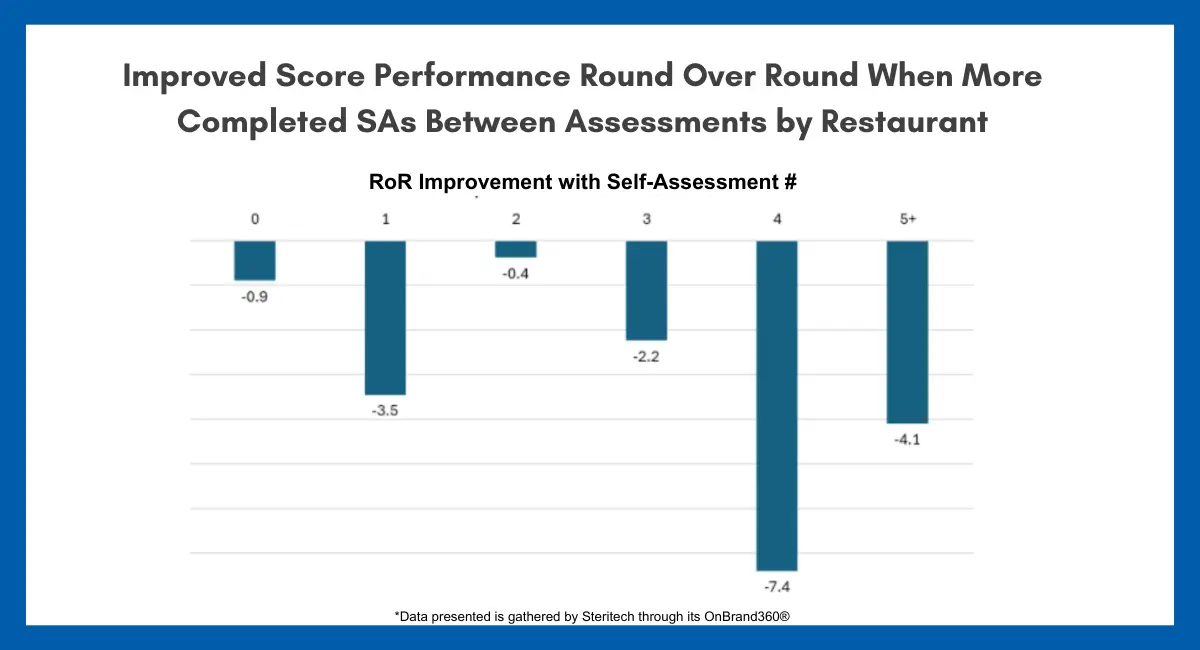
Source: Steritech Internal Data, 2025. Lower scores indicate better compliance.
This isn’t just correlation. It’s a trend we’ve seen across brands, geographies, and concepts. Teams that regularly assess themselves don’t just feel more prepared. They are more prepared.
The Priority Focus Self-Assessment: A targeted model for busy teams
In today’s operating environment, time is tight. Many restaurant teams continue to run lean post-COVID, with limited bandwidth and competing priorities. For some brands, this has made full-scope Self-Assessments difficult to complete regularly.
That’s why Steritech developed the Priority Focus Self-Assessment model. This streamlined approach centers on the most critical areas of the operation:
- First Priority Food Safety standards – items directly linked to foodborne illness prevention
- Key Operational Excellence standards – for brands with OpsEx programs, this includes high-impact elements that shape the guest experience
These focused assessments typically take just 30 to 60 minutes, depending on the complexity of the operation. Brands using this model report that their teams find it more manageable, relevant, and effective. It reinforces what matters most, without overwhelming busy shifts.
Steritech recommends conducting one Priority Focus Self-Assessment per week, led by a rotating member of the restaurant leadership team–not just the GM.
| Frequency | Scope | Time Needed | Key Benefit |
|---|---|---|---|
| Monthly | Full scope of professional assessment | 1–2 hours | Builds broad awareness and operational discipline |
| Every 2 weeks | Half the scope, alternating each cycle | 30 mins to 1 hour | Increases frequency without being overly time-consuming |
| Weekly | ¼ of the full scope; full cycle completed every 4 weeks | 15–30 minutes | Keeps focus fresh and increases team participation |
| Daily | ⅕ of the full scope, assessed over 5 days | 10–20 minutes | Enables the deepest look at each section and engages more team members more often |
Steritech also works with clients to customize assessments for special initiatives, such as new menu rollouts, POS system updates, or operational launches. These targeted assessments help drive consistency during times of change.
Best practices for high-impact self-assessments
To get the most from Self-Assessments, brands should consider not just how often they’re done but how they’re executed.
Who should lead them?
Rotate among roles: restaurant managers, ARLs, shift supervisors, franchisees, even frontline staff. This builds awareness and spreads responsibility across the team.
What’s the ideal scope?
Shorter, more focused assessments tend to be more useful in day-to-day operations. Full assessments still have their place–Steritech recommends a full Self-Assessment be completed monthly by the GM or an above-restaurant leader to ensure broader oversight.
When should they happen?
Rotate the days and times. A location might look great at 10 a.m. when fully staffed and freshly prepped. But what happens at 2 p.m. after a hectic lunch rush? Assessing under different conditions provides a clearer picture of true performance.
What mindset should teams bring?
Approach every Self-Assessment as an opportunity to uncover, not avoid, problems. The teams that find the most improvement opportunities are the ones that grow the most.
Technology-enabled accountability and visibility
Steritech’s Self-Assessment platform, integrated with OnBrand360®, simplifies and strengthens the entire process. It helps turn insight into action and supports consistency at scale.
- Digitized Checklists make it easy for teams to follow procedures correctly every time
- Real-Time Reporting gives brand leaders visibility into compliance across locations
- Trend Analysis identifies recurring issues before they escalate
- Corrective Action Tracking ensures that problems don’t fall through the cracks
These tools support a food safety culture that is consistent, proactive, and resilient.
Consistency is a strategy, not a slogan
Consistent Self-Assessments do more than improve scores. They help operators uncover blind spots, catch issues early, and reinforce food safety behaviors every day. For brands, they support reliable experiences, reduced risk, and better long-term performance.
Self-Assessments aren’t just a box to check. They’re a flexible, strategic tool that can be adapted to meet the needs of the moment–from building foundational discipline to reinforcing behaviors during operational change.
With the right tools, rhythm, and intent, Self-Assessments help teams move beyond compliance into true operational excellence.
Want to learn more about how Steritech’s Self-Assessment platform can help your brand drive consistency and performance? Contact us to schedule a demo.
Contact Steritech for a free survey or quote and obtain our experts will get back to you as soon as we can
Gain helpful insight from Steritech’s library of industry info and resources.