© 2026 Rentokil Initial plc and subject to the conditions in the legal statement..
Most leaders can point to strong programs with confidence. SOPs are documented, training is established and policies are clearly defined, all of which create the sense that the system is doing what it was designed to do. Yet results still vary from location to location, shift to shift and team to team. The gap between what exists on paper and what shows up in daily operations is familiar, even if it rarely gets named directly.
The explanation usually isn’t negligence or a lack of care. In most organizations, the issue takes shape much more quietly. Between how a program is intended to function and how it actually operates under real conditions, a small but consequential space opens. Over time, that space allows execution to drift. Risk accumulates gradually, not in a single moment, and by the time a visible failure demands attention, the underlying inconsistency has often been present for weeks or months.
Program design isn’t the weak link
Most large foodservice and retail organizations already operate with mature, well-constructed programs. Standards are developed with care, training materials are thorough and compliance frameworks are built to address known risks and regulatory expectations. In many cases, these programs reflect years of refinement and institutional learning rather than quick fixes.
Program design also benefits from its visibility. It can be documented, reviewed and audited, which makes it easier for leaders to reference as evidence that expectations have been clearly established. That documentation naturally draws attention, particularly in organizations where accountability is closely tied to what can be measured and proven.
What design cannot do on its own is ensure that those expectations show up consistently in daily operations. Written standards outline how work is meant to happen, but they don’t control how conditions, pressures and human judgment shape execution in real time. Consistency emerges, or erodes, in those moments, not in the documents that describe them.
Why identical SOPs don’t produce identical outcomes
Execution takes place in environments that SOPs can’t fully control. Staffing levels fluctuate, turnover creates ongoing experience gaps and new employees often interpret instructions differently than more seasoned team members. Shift handoffs introduce subtle variation, and local leadership habits quietly influence which behaviors get reinforced and which ones slide.
These differences are rarely intentional. In most cases, they emerge as small adjustments made to keep pace with volume or manage day-to-day pressure. Steps get shortened during busy periods, standards are interpreted more loosely in the moment and new hires tend to follow what they observe on the floor rather than what they were taught in training.
Over time, those small adjustments begin to compound. What starts as a minor deviation gradually becomes an accepted way of working. Across days and weeks, execution drifts further from the original standard, not because anyone made a conscious decision to abandon it, but because there was no mechanism to understand how closely daily behavior continued to align with intent.
Where the consistency gap actually forms
The consistency gap rarely originates during audits or inspections. It forms in the periods between them, where training meets the pressure of a real shift and written expectations encounter staffing levels, pace and competing priorities. These are the moments when execution is most likely to vary, even when standards are clearly defined.
Audits and inspections play an important role in verifying performance at a point in time. But they capture outcomes after routines have already been established. By the time performance is reviewed following an incident, the gap has usually been present for some time. The failure marks when the issue becomes visible, not when it first took hold.
This is where the conversation needs to move from review to execution. When organizations look at consistency only after something goes wrong, they end up reacting to outcomes instead of examining the day-to-day conditions that allowed inconsistency to develop.
Operational excellence is about repeatability
Operational excellence is often discussed in terms of flawless execution, yet real-world operations rarely work under flawless conditions. What sustains performance over time is the ability to produce the same outcomes across people, shifts and locations, even when volume is high or resources are stretched. Repeatability is what keeps systems stable.
Individual high performers still matter, but organizations cannot rely on exceptional effort to compensate for everyday variability. When execution is repeatable, standards hold even as conditions change. Consistency turns into habits, and habits create reliability across the operation.
That reliability has a direct effect on risk. Predictable execution keeps exposure contained and manageable, while inconsistency allows small issues to escalate. Framing excellence around repeatability shifts attention away from isolated wins and toward the conditions that make steady performance possible.
Inconsistency as an early warning signal
Consistency is not a quality score in itself. It is a stress test of execution, a way to see whether systems hold up before outcomes change.
Quality metrics document results after the fact: incident rates, failed audits, customer complaints. Inconsistency shows up earlier, when standards are technically still being met but execution starts to vary by shift, location or day. Those small deviations signal weakening discipline long before they register as measurable failures.
Seen this way, consistency functions as a leading indicator of operational health, while traditional quality metrics confirm what has already happened.
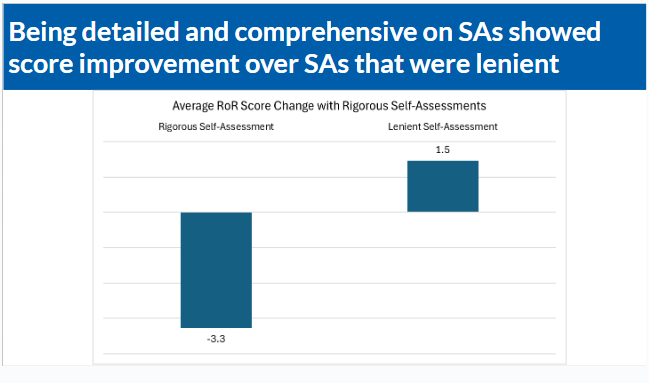
Internal analysis shows that locations using more rigorous self-assessments experience greater improvement over time than those applying more lenient standards, reinforcing the value of surfacing execution gaps early rather than smoothing them over.
By the time failures surface, the underlying consistency gap has usually been in place for some time. Leaders who wait for outcomes to change before paying attention often miss the earliest and most manageable signals, when intervention is still relatively straightforward.
Earlier awareness of inconsistency gives organizations the opportunity to respond while issues remain contained and correctable, rather than reacting after they have already escalated.
Why reacting to failures keeps leaders one step behind
The traditional response cycle is familiar across many organizations. An incident occurs, a root cause analysis follows, training is refreshed and expectations are restated, creating the sense that the system has been reset until the next failure restarts the process. Each step feels purposeful, yet the pattern tends to repeat.
This approach treats breakdowns as isolated events rather than signals of broader system behavior. Attention narrows to the exception instead of the conditions that allowed it to develop, leaving leaders managing individual failures rather than strengthening the system as a whole. While the response often feels decisive in the moment, the variability that allowed the issue to emerge remains largely intact.
Without sustained awareness of how execution shifts over time, organizations default to reacting after problems surface rather than understanding how they developed in the first place.
Using data to detect drift before it becomes failure
A more resilient approach begins with ongoing observation built into everyday operations. When execution is measured consistently over time, patterns start to surface. Gradual declines become easier to spot, variation across people, shifts and locations becomes more apparent and early signals appear well before incidents force action.
In this context, consistency data functions as an early warning system rather than a scorecard. It highlights where execution is starting to drift before that drift shows up in lagging indicators like incidents, failed audits or complaints. Used thoughtfully, it helps leaders focus attention where it matters most, while issues are still contained and manageable.
This kind of shift doesn’t depend on predicting future failures. It depends on understanding present conditions well enough to respond before small deviations become systemic problems.
The leadership responsibility in closing the gap
Closing the consistency gap depends less on writing new policies and more on sustaining execution over time. Leadership responsibility continues well beyond setting standards and extends into how reliably those standards show up under real operating conditions, across locations, shifts and teams.
Maintaining that reliability requires ongoing attention and reinforcement. The most resilient operations are those leaders can trust to perform with the same discipline on a quiet Tuesday as they do during peak pressure, when systems are tested most heavily.
Consistency at this level doesn’t eliminate problems altogether. It limits their ability to grow, keeping small issues contained before they develop into larger, more disruptive failures.
*Data presented is gathered by Steritech through its OnBrand360®
Contact Steritech for a free survey or quote and obtain our experts will get back to you as soon as we can
Gain helpful insight from Steritech’s library of industry info and resources.