© 2026 Rentokil Initial plc and subject to the conditions in the legal statement..
As operators step into a new year, many resolutions focus on tightening routines or getting teams anchored in the fundamentals. The practices that endure tend to be the ones rooted in daily behavior. January offers a natural inflection point to reset expectations around the details that reveal how a location truly operates and how well a brand’s systems hold up under pressure. As Doug Sutton, President of Steritech, notes, “Food safety excellence is rarely the result of a single heroic effort. It is the product of steady, daily habits. January provides a critical window to anchor teams in the fundamentals from the restrooms to the storage areas that act as lead indicators for the entire system.”
The year ahead will place more weight on environmental execution. Health Department inspectors are paying closer attention to the signals that show whether routines are steady or starting to slip, from restrooms and storage areas to the front of the house. These spaces often act as lead indicators of discipline. When they are in good shape, it usually means habits are consistent across shifts. When they are not, the issue often traces back to a breakdown in process rather than a single missed task. Sutton describes these cues directly. “Cleanliness isn't just an aesthetic choice. It is a high-definition snapshot of an operation's discipline.”
Food safety now extends far beyond line checks or temperature logs. Expectations around visibility, documentation and consistency continue to grow, and environmental conditions provide a direct read on whether those expectations are being met. These conditions reflect how well teams understand their roles, whether they close the loop on tasks and how much stability the operation has during peak hours. Guests respond to these patterns, and their impressions influence satisfaction ratings, repeat visits and word of mouth. As Sutton puts it, “Guests and inspectors alike view environmental execution as a proxy for food safety and a great overall experience.”
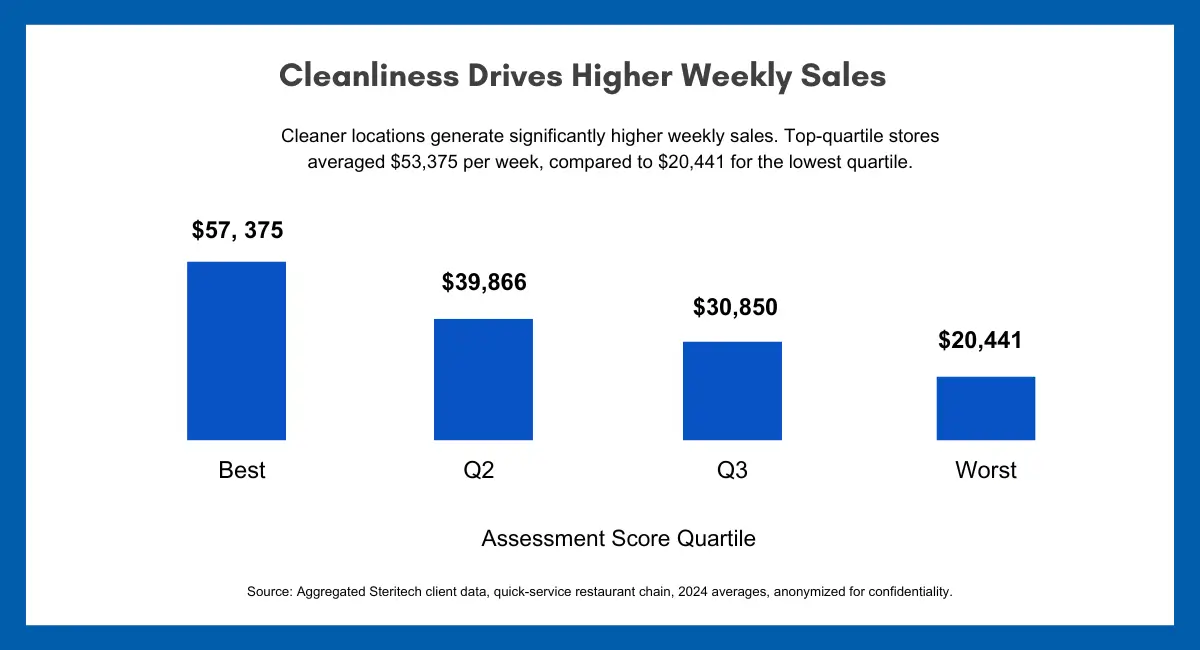
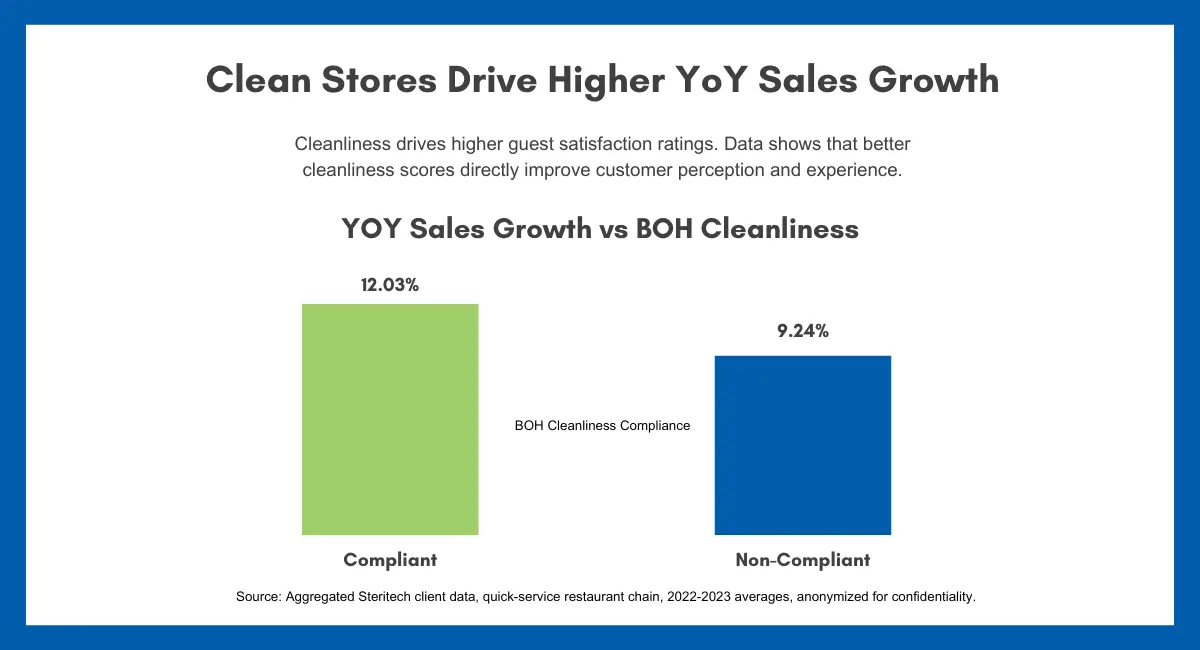
The business impact appears clearly when performance is compared across locations. Stores with stronger environmental execution consistently outperform those that struggle. In one large quick service chain, the top quartile for cleanliness generated an average of $57,375 compared to $20,441 in the lowest quartile. Year over year sales growth followed the same pattern. Locations that met cleanliness expectations grew at 12%, while non compliant locations grew at 9%.
In other words, cleaner stores grew at a rate 33% better. Guest survey data tracks closely with these results, showing strong alignment between perceived cleanliness, food safety performance and overall execution. Sutton points to this exact pattern. “When we see a 33% difference in growth between clean and not-so-clean stores, it tells us that starting the year with a focus on these routines is not just about a reset. It is about building the predictability that protects the brand and drives the bottom line.”
These patterns point to something larger than a single cleanliness win. Environmental execution is often a reliable indicator of operational predictability. When cleanliness routines hold, other systems tend to hold as well. When they slip, the same drift often appears in training, food safety controls and guest experience. Beginning the year with stronger environmental routines is one of the most effective ways to stabilize performance across a system. Sutton explains this interdependence. “When environmental execution is consistent, it creates a stabilizing effect that allows every other part of the operation from training to guest experience to hold firm under pressure.”
Refining restroom and storage workflows, clarifying front of house expectations and reinforcing simple cleanliness habits often reduce surprises during evaluations. These steps support alignment across teams and help operators maintain steady performance through seasonal swings and changing traffic patterns.
Brands that strengthen environmental execution early in the year often see the benefit throughout the operational cycle. Evaluation performance improves when foundations are steady. Guest satisfaction rises when cleanliness is visible and consistent. And teams stay aligned when expectations are simple and reinforced through daily habits. If one resolution keeps its value month after month, it is the one grounded in routines that shape every shift and every guest experience. Cleanliness sets the pace for the year ahead and remains one of the strongest indicators of operational health.
*Data presented is gathered by Steritech through its OnBrand360®
Contact Steritech for a free survey or quote and obtain our experts will get back to you as soon as we can
Gain helpful insight from Steritech’s library of industry info and resources.