© 2026 Rentokil Initial plc and subject to the conditions in the legal statement..
Steritech data links higher digital satisfaction with stronger same-store sales performance. But many assessment programs may not capture what happens after the customer places the order.
As digital ordering, pickup and delivery become a larger part of how customers interact with brands, assessment programs built primarily around the traditional in-person experience can leave a significant blind spot. A location may perform well for the customer standing at the counter while delivering a very different experience to the customer arriving for a digital order.
For one Steritech client, the data provides another reason to pay attention to the digital experience. Locations with higher Digital Guest Overall Satisfaction (OSAT) tended to have stronger same-store sales performance. At the lower end of the analysis, locations with Digital OSAT of approximately 43% had same-store sales growth of about -3.3%, while locations at approximately 83% Digital OSAT had same-store sales growth of about 2.5%. In fact, Digital OSAT had a stronger relationship with same-store sales than non-digital OSAT did.
The finding does not mean higher digital satisfaction causes stronger sales, but the relationship makes it important to understand what is happening within that experience. For multi-location brands, that raises an important question: If digital represents a meaningful part of how customers interact with your business, are you measuring that experience with the same rigor as the one happening inside your locations?
“The digital experience is no longer separate from the overall guest experience,” says Kim McDonald, CP-FS, Director – QSR, Technical Services at Steritech. “For many brands, digital ordering is a significant part of how customers interact with them. If that experience is easy, accurate and consistent, it can influence whether a guest returns and ultimately how the restaurant performs.”
What Happens After the Digital Transaction?
A digital experience may begin with an app or website, but much of what determines customer satisfaction happens after the order is placed. Order accuracy, readiness at the promised time, pickup location and signage, employee interaction, packaging, product quality and issue resolution all contribute to the experience.
That creates a measurement challenge. A completed transaction can confirm that the technology did its job, but it cannot show whether the customer found the pickup area easily, received the correct order at the promised time or encountered an employee prepared to assist them.
“One of the biggest gaps we see is between the process that was designed and what actually happens in the restaurant,” McDonald says. “A brand may have a great digital process on paper, but if the pickup area is unclear, the order is not ready, or the team does not know how to engage with a digital guest, the customer experience can feel very different from what was intended.”
For leaders, that gap can be difficult to see from conventional digital metrics alone. Transaction data can show whether an order was placed, and customer feedback can identify dissatisfaction after it occurs. Neither necessarily shows where the intended experience breaks down as the digital transaction is fulfilled at the location.
What Are Your Current Assessments Missing?
The question for brands with established assessment programs is not necessarily whether they are measuring performance. It is whether they are measuring the parts of the customer journey that have become increasingly important to the business.
An assessment focused primarily on the traditional in-location experience may provide a strong picture of cleanliness, service, hospitality and other operational standards while providing less visibility into the experience of customers arriving through digital channels.
“If we only assess the traditional ‘in restaurant’ experience, we may miss issues that have the greatest impact on a growing portion of customers,” McDonald says.
Observing the experience from the customer’s perspective can provide another layer of visibility. Steritech’s Blind Brand Experience Visits include onsite and off-premise assessments designed to evaluate the experience customers actually receive. For a digitally initiated journey, that can mean examining the full experience, from ordering and promised-time readiness through pickup, employee interaction, order accuracy and product quality.
The objective is not simply to add another assessment. It is to determine whether the assessment program is still measuring the parts of the customer journey that can reveal where execution differs from what the brand intended.
Why the Digital OSAT Data Deserves Attention
For one Steritech client, the potential importance of that visibility showed up in the business data. Locations with higher Digital OSAT tended to have stronger same-store sales performance, and the relationship between Digital OSAT and same-store sales was stronger than the relationship between non-digital OSAT and sales.
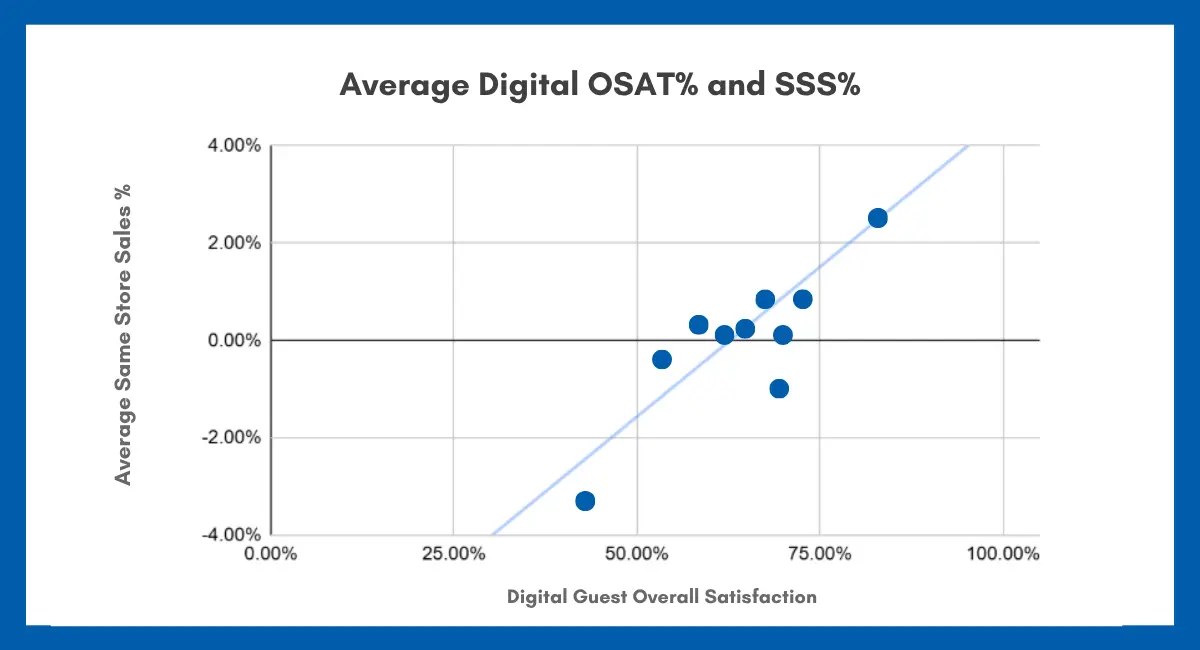
The analysis does not establish that higher digital satisfaction causes higher sales. Sales performance can be affected by many variables, and the finding represents a correlation within this particular client dataset.
“The correlation indicates these measures are moving together and gives us a strong reason to better understand and measure the digital experience, but it does not by itself prove causation,” McDonald says.
That makes the question behind the score particularly useful. If Digital OSAT is associated with an important business outcome, leaders have reason to understand what is producing that satisfaction, and whether their existing measurements can identify the operational conditions contributing to it.
The business value is not in treating Digital OSAT as a predictor of sales. It is in recognizing that an experience showing this kind of relationship with business performance warrants greater visibility into what customers are actually encountering.
Does Your Assessment Program Match Your Business Today?
Digital ordering crosses boundaries that can look separate inside an organization. The technology may belong to one team, operations to another and customer experience to another. The customer experiences all of them as one brand.
That makes assessment program design an executive issue. Leaders need enough visibility across customer touchpoints to determine whether standards established at the organizational level are producing the intended experience at individual locations.
For some brands, that may mean taking a closer look at digital and off-premise experiences. For others, the same exercise may identify different parts of the business that have grown or changed faster than the systems used to measure them. The question is whether assessment priorities still align with where customers interact with the brand and where execution can affect business performance.
As customer behavior changes, assessment programs need to keep pace with the business they are designed to measure. If digital has become an important part of the customer experience, leaders should know whether the experience designed at headquarters is the one customers are actually getting.
Are You Measuring the Experience Your Customers Actually Receive?
Steritech’s OnBrand360® programs help brands evaluate the customer experience across the touchpoints that matter to their business, including in-location, digital and off-premise experiences. Gain greater visibility into how brand standards are being executed across locations and where opportunities may be affecting the customer experience.
Explore OnBrand360® or contact us for more information.
*Data presented is gathered by Steritech through its OnBrand360®
Contact Steritech for a free survey or quote and obtain our experts will get back to you as soon as we can
Gain helpful insight from Steritech’s library of industry info and resources.